Phytonutrients, Polyphenols and Flavonoids: Nature’s Powerful Antioxidants
In today’s information-packed world, increasing your health literacy is one of the most effective ways to take control of your well-being. When you understand how specific nutrients work in your body, you become better equipped to make informed food choices that promote long-term health, resilience, and disease prevention. Three important plant-based compounds worth knowing are phytonutrients, polyphenols, and flavonoids. To keep it very simple these terms are another more specific way to describe antioxidants.
Phytonutrientsare bioactive compounds found in plants that offer significant health benefits. Two of the most well-known and extensively studied categories are polyphenols and flavonoids. While these terms can sound technical, they’re essentially specialized types of antioxidants.
Phytonutrients function as antioxidants, helping to neutralize free radicals and protect your cells from oxidative damage. Your body constantly balances oxidants (like free radicals) and antioxidants. When this balance tips toward oxidants, likely due to stress, poor diet, pollution, or aging. It can also lead to an increase of cellular damage and disease risk.
Polyphenols: The Largest Class of Dietary Antioxidants
Polyphenols are abundant in the leaf tissues of plants, where they help deter predators and protect the plant from environmental stress. In the human diet, they represent the largest and most diverse group of antioxidants. You’ll find them concentrated in many plant-based foods.
Flavonoids: A Key Subclass of Polyphenols
Flavonoids are a major subgroup of polyphenols, further divided into six main classes: **flavonols, flavones, flavanones, flavan-3-ols, anthocyanidins, and isoflavones.
Each class contains specific compounds. For example, flavonols — one of the most common flavonoid types — include well-known phytonutrients such as quercetin, kaempferol, myricetin, and isorhamnetin.
Flavonoids are prized for their wide range of medicinal properties, including:
- Strong antioxidant activity
- Anti-inflammatory effects
- Anticancer potential
- Antiviral properties
- Neuroprotective and cardioprotective benefits
Best Food Sources of Phytonutrients
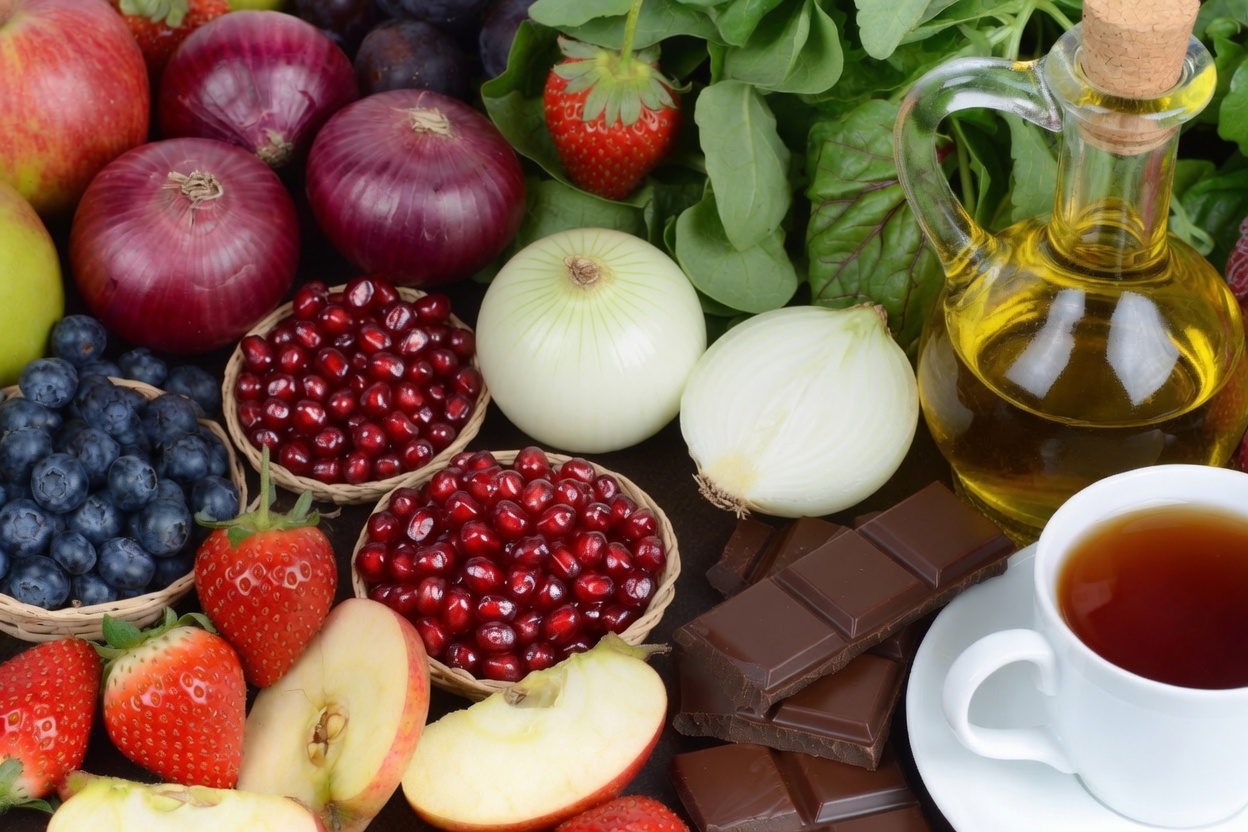
Tip: To boost your intake of phytonutrients (including polyphenols and flavonoids), focus on colorful, whole plant foods:
Vegetables and fruits (preferably in season, especially brightly colored varieties and choose organic when possible to minimize exposure to pesticides and toxins.)

- Nuts and seeds
- Extra virgin olive oil
- Tea (green, black, and herbal)
- Coffee
- Dark chocolate (70%+ cocoa)
- Red wine (in moderation)
- Spices and herbs
- Beans
Flavonoid Powerhouses (mg per 100g)
Standout sources include:
- Raw and cooked onions
- Apples (with the peel)
- Brewed black tea (including decaf)
- Dark chocolate (70%+ cocoa)
Daily Tips for Boosting Phytonutrient Intake
- Start your day with a handful of berries or pomegranate seeds.
- Add onions to salads, soups, or stir-fries — raw or cooked.
- Swap your usual beverage for green or black tea.
- Replace a snack with a serving of 70%+ dark chocolate.
- Use plenty of herbs, spices, and extra virgin olive oil when cooking.
- Aim for a “rainbow” plate — the more colorful your meals, the broader the phytonutrient variety.
By making small, consistent choices like these, you can significantly increase your intake of these powerful plant compounds. Raising your health literacy around phytonutrients, polyphenols, and flavonoids empowers you to nourish your body more effectively every day. The best defense against oxidative stress and inflammation is often as simple as eating more real, colorful food. Start incorporating these tips today and give your body the antioxidant support it deserves.
Keep the faith,
The entire contents of this blog are based upon the opinions/research of Corey Diggins, unless otherwise noted. Individual articles are based upon the opinions of the respective author, who retains copyright as marked. The information on this blog is not intended to replace a one-on-one relationship with a qualified health care professional and is not intended as medical advice. It is intended as a sharing of knowledge and information from the research and experience of Corey Diggins. Corey Diggins encourages you to make your own health care decisions based upon your research and in partnership with a qualified health care professional.
References:
1. General Overview & Health Benefits
Pandey, Kavita B., and Syed Ibrahim Rizvi. “Plant Polyphenols as Dietary Antioxidants in Human Health and Disease.” Oxidative Medicine and Cellular Longevity, vol. 2, no. 5, 2009, pp. 270–278. PubMed Central, https://www.ncbi.nlm.nih.gov/pmc/articles/PMC2835915/.
2. Flavonoids – Classes, Sources & Benefits
Panche, Aditya N., et al. “Flavonoids: An Overview.” Journal of Nutritional Science, vol. 5, 2016, e47. Cambridge Core, https://www.cambridge.org/core/journals/journal-of-nutritional-science/article/flavonoids-an-overview/4A4A2E2A6E2A4A8A8E8A8E8A8E8A8E8A. doi:10.1017/jns.2016.41.
3. Dietary Sources & Specific Content (Onions, Apples, Tea, Chocolate)
U.S. Department of Agriculture. USDA Database for the Flavonoid Content of Selected Foods, Release 3.1. Agricultural Research Service, 2015, https://www.ars.usda.gov/ARSUserFiles/80400525/Data/Flav/Flav_R03-1.pdf.
Figure 1.
Korn, Leslie. “The Brainbow Blueprint™ Diet: The Underrated Simplicity of Color Diversity in Nutrition.” Dr. Leslie Korn, drlesliekorn.com/blog/brainbow-blueprint-foods/. Accessed 15 July 2026.


0 Comments