Butyrate, a gut health powerhouse.
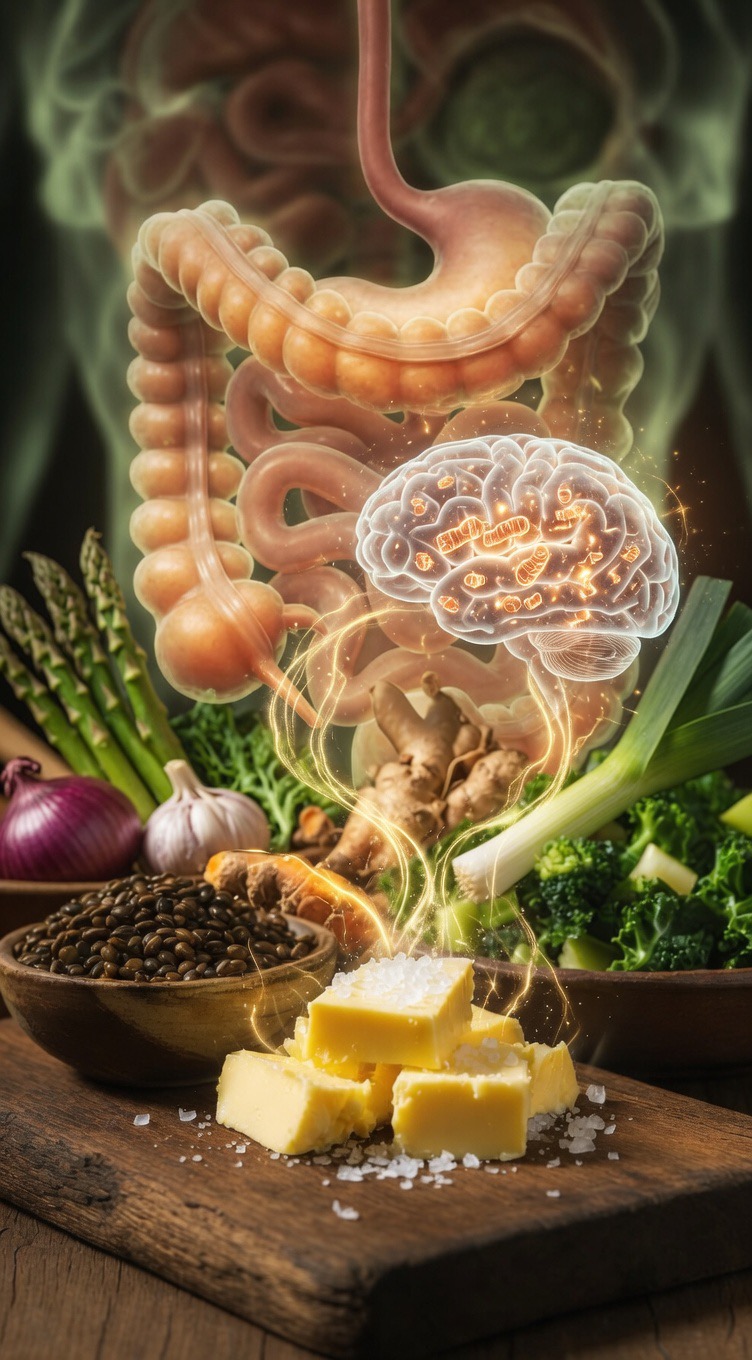
If you’ve been walking this Native Living path with me, you already know the truth that hit me hard after my brainstem stroke and surgery five years ago: real healing doesn’t come from chasing symptoms or popping pills. It comes from returning to how we were designed, grounded to the Earth, eating in rhythm with the light-dark cycle, and feeding the gut buddies that quietly run the whole show.
At the center of that quiet power is butyrate; a short-chain fatty acid your own microbiome manufactures when you give it the right targeted prebiotics. Butyrate isn’t just “good for the gut.” It’s a gut health powerhouse that fuels your colon lining, tames inflammation, strengthens the barrier against leaky gut, and sends signals that support mitochondrial uncoupling. The very process that lets your cells burn cleaner, build more mitochondria, and lower the oxidative stress that can keep a recovering nervous system stuck in survival mode.
In my personal protocol, butyrate production is a main reason I feel steady energy, mental clarity, and that deep sense of the body repairing instead of just managing. This is why I prioritize specific foods and not just random choices. They’re intentional fuel for the bacteria that turn polyphenols and fibers into post-biotics like butyrate and acetate—nature’s signals for mild uncoupling, lower ROS, and healing.
This isn’t about eating massive amounts of fiber or forcing anything extreme. It’s about targeted nourishment in a lectin-free, high-fat, whole-food context that lets the right bacteria thrive while the rest of Native Living (grounding, strategic light, minimal EMF and toxins) removes the interference. When butyrate flows, the gut-brain axis is coherent, the vagus nerve has the correct tone, and the same mechanisms that protect mitochondria in the gut also help the brain and autonomic nervous system.
In the rest of this post I’ll break down exactly what butyrate does, why it’s especially powerful after a neurological challenge, and the simple daily choices in my routine that keep those butyrate-producing bacteria happy and productive. Because when you feed the foundation, everything else lives in creation mode instead of fear.
What butyrate actually is & how it’s made
Butyrate (along with acetate and propionate) is a short-chain fatty acid produced when specific gut bacteria ferment resistant starches, polyphenols, and certain fibers in the colon. Key producers include species like Faecalibacterium prausnitzii and Roseburia. In a lectin-free context the microbiome adapts beautifully because we’re not constantly irritating the lining or feeding the wrong bacteria.
Butyrate helps produce gut hormones that regulate blood sugar levels, which may help with insulin resistance and obesity. Some evidence also suggests that butyrate may help induce sleep.

Mitochondrial uncoupling connection
Butyrate acts as both fuel and signal for mitochondria. It enhances oxidative phosphorylation (similar to a hydroelectric dam that generates cellular power) upregulates uncoupling proteins, and helps protect mitochondria under stress while supporting cleaner energy production.
Gut barrier & inflammation powerhouse
Butyrate is the preferred energy source for colonocytes (the primary cells that line the inner surface of the colon). It strengthens tight junctions, increases mucus production, and reduces intestinal permeability (leaky gut) and limits toxins in the blood. It’s potently anti-inflammatory—calms NF-κB, supports regulatory T-cells, and lowers systemic cytokines. It really is one of the best chemical compounds for gastrointestinal health. It can also help protect against intestinal diseases like inflammatory bowel disease and colon cancer.

Post-stroke & gut-brain axis caveat
After brainstem injury, many face secondary mitochondrial dysfunction and gut-brain axis disruption. Butyrate helps on multiple fronts: it reduces neuroinflammation (including microglia activation), supports blood-brain barrier integrity, and has been shown in research to improve outcomes and functional recovery in stroke models.
Practical understanding and application
In summary through fermentation, our little gut buddies are producing metabolites one of which are butyrate, an organic compound that belongs to the group of short-chain fatty acids.
One of the main bacteria that produces butyrate is Faecalibacterium prausnitzii. This microbial powerhouse has numerous benefits, including:
- Anti-inflammatory effects
- Empowering intestinal barrier function
- Influencing mucus production in the gut
We know that inulin feeds our Faecalibacterium prausnitzii bacteria which makes butyrate and delivers the above benefits. So, how do we increase our Faecalibacterium prausnitzii bacteria?
How can you raise Faecalibacterium prausnitzii in your gut?
The typical bacteria added to yogurts or sold as supplements are able to survive when exposed to air. However, Faecalibacterium prausnitzii bacteria are “oxygen-sensitiive,” such that they die within minutes of exposure to air. This means there is no way to take a probiotic supplement containing Faecalibacterium prausnitzii, Instead we have to turn to food.
Understanding our Gut microbiome is complex. A framework to understand Pro/Pre and Postbiotics can help.
Probiotics are microorganisms that increase your population of good bacteria. Certain foods and drinks are good sources of probiotics, but you can also take them as pills or powders.
Prebiotics are compounds found in foods. We can’t digest prebiotics alone; instead they provide the fuel or food needed for our good bacteria to eat in our Gut microbiome. By consuming foods rich in prebiotic fiber our gut will send a message to the brain that it’s satisfied and we’ll feel less hungry and crave healthier foods as a result. One of the best prebiotics is inulin.
Postbiotics are the bioactive compounds the probiotic bacteria produce when they consume prebiotics. Think our probiotics eat the prebiotics that digest and make our postbiotics!
Inulin is an amazing source that’s a must in our dietary regime. Inulin butyrate production is the result of inulin being fermented by intestinal bacteria in the gut.
Common vegetables with Inulin are asparagus, onions, leeks, garlic, chicory root, Jerusalem artichokes, burdock and dandelion root. Additionally, the avocado contains bacteria such as Faecalibacterium, Lachnospira, and Alistipes, all of which produce short-chain fatty acids (SCFAs), including butyrate.
We can also get a great source of butyrate from specific dairy products. It’s a significant component of the fatty acid profile in milk due to the fermentation process occurring in the rumen. Sheep and Goat products have a slightly higher level of these (SCFAs.) Butter (especially from grass-fed or pasture-raised animals) is one of the richest direct dietary sources of butyrate. Unlike most butyrate, which your gut bacteria must produce by fermenting prebiotics, butter delivers ready-to-use butyrate straight from the food. This provides an immediate supply for your colonocytes (the cells lining your colon) which use butyrate as their primary energy source.
Not prioritizing our gut microbiome could make us more susceptible to pathogens, toxins and foreign bacteria passing into our body. This much we know for certain so it’s good to protect our Gut. Additionally with the latest research supporting most Neurodegenerative diseases and others stemming from our gut, it’s a great place to dial in for healthy living.
Keep the faith,
The entire contents of this blog are based upon the opinions of Corey Diggins, unless otherwise noted. Individual articles are based upon the opinions of the respective author, who retains copyright as marked. The information on this blog is not intended to replace a one-on-one relationship with a qualified health care professional and is not intended as medical advice. It is intended as a sharing of knowledge and information from the research and experience of Corey Diggins. Corey Diggins encourages you to make your own health care decisions based upon your research and in partnership with a qualified health care professional.
Resources:
Kalkan, Ayşe E., et al. “Beyond the Gut: Unveiling Butyrate’s Global Health Impact and Therapeutic Potential.” Nutrients, vol. 17, no. 13, 2025, pmc.ncbi.nlm.nih.gov/articles/PMC12029953/. Accessed 10 July 2026.
Mayorga-Ramos, Arantxa, et al. “Protective Role of Butyrate in Obesity and Diabetes: A Review.” Frontiers in Nutrition, vol. 9, 2022, www.frontiersin.org/journals/nutrition/articles/10.3389/fnut.2022.1067647/full. Accessed 1 July 2026.
Rose, Shannon, et al. “Butyrate Enhances Mitochondrial Function During Oxidative Stress in Cell Lines from Boys with Autism.” Translational Psychiatry, vol. 8, no. 1, 2018, www.nature.com/articles/s41398-017-0089-z. Accessed 1 July 2026.
Silva, Ygor Parladore, et al. “The Role of Short-Chain Fatty Acids From Gut Microbiota in Gut-Brain Communication.” Frontiers in Endocrinology, vol. 11, 2020, www.frontiersin.org/journals/endocrinology/articles/10.3389/fendo.2020.00025/full. Accessed 1 July 2026.
“What Is Butyrate? Benefits and Side Effects.” Cleveland Clinic, 11 July 2022, health.clevelandclinic.org/butyrate-benefits. Accessed 10 July 2026.
“Why Short Chain Fatty Acids Are Important for a Healthy Gut?” Gut Microbiota for Health, 6 Apr. 2023, www.gutmicrobiotaforhealth.com/why-short-chain-fatty-acids-are-important-for-a-healthy-gut/. Accessed 8 July 2026.
“Beneficial Bacteria: A Focus on Faecalibacterium prausnitzii.” GUTXY, 1 May 2024, www.gutxy.com/blog/beneficial-bacteria-a-focus-on-faecalibacterium-prausnitzii/. Accessed 22 November 2025.
Gilbert, Jack A., et al. “Permissive Microbiome Characterizes Human Subjects with a Neurovascular Disease Cavernous Angioma.” Nature Communications, vol. 11, no. 2659, 27 May 2020, www.nature.com/articles/s41467-020-16436-w. Accessed 22 November 2025.
Figure 1. (Comprehensive butyrate benefits infographic)
Kalkan, Ayşe E., et al. “Beyond the Gut: Unveiling Butyrate’s Global Health Impact and Therapeutic Potential.” Nutrients, vol. 17, no. 13, 2025, pmc.ncbi.nlm.nih.gov/articles/PMC12029953/. Accessed 10 July 2026.
Figure 2. (Gut-brain axis illustration)
“Microbiota–Gut–Brain Axis and Its Therapeutic Applications in Neurodegenerative Diseases.” Signal Transduction and Targeted Therapy, Nature, 2024, www.nature.com/articles/s41392-024-01743-1. Accessed 10 July 2026.


0 Comments