The Paradox of Sugar
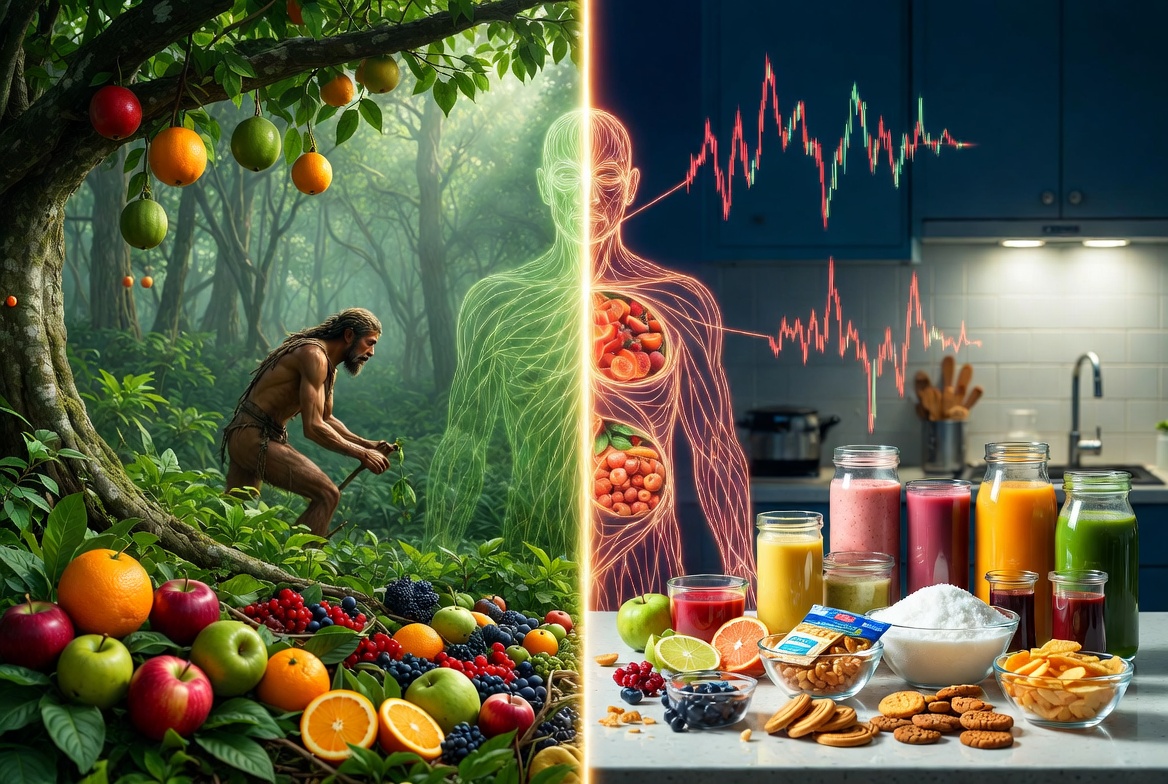
“Sugar is fundamental to human biology, but in excess especially in modern forms it drives fat storage, metabolic dysfunction, obesity, and disease. Understanding it from first principles empowers better choices.”
You feel good about your choices: skipping the soda, grabbing a fruit-on-the-bottom yogurt, or sipping a fresh-pressed juice. These are the “good” sugars, right? But here’s the modern paradox, sugar is in nearly everything we eat, celebrated in whole foods and condemned in processed ones, yet our obesity and metabolic disease rates keep climbing. We’ve never been more confused about something our bodies literally run on. Today sugar is hard to avoid, year-round, added into smoothies already high in sugar, sauces, and “healthy” snacks. We’ve engineered abundance out of something meant to be scarce. This is the great sugar paradox! essential for human biology, yet drives fat storage, obesity, and disease when over-consumed. Let’s go back to the basics, what sugar actually is!? How it works in your body, and why excess (even from fruits and veggies) can quietly sabotage your health.
In the mainstream health lens today were fed information about how dangerous not exercising can be or eating greasy foods but seldom do we hear serious lengthily discourse about sugar. So, unless we do our own research, we form a limited belief to avoid what we hear and don’t give sugary foods much thought except they can cause cavity’s.
Let’s take a first principled look at sugar, meaning break it down to its fundamental pieces to see how it works. At the most basic chemical level, sugars are small molecules made of carbon, hydrogen, and oxygen. Arranged in a specific sequence we get the smallest and most important sugars in biology, they are monosaccharides (“single sugars”). Generally speaking, in organic chemistry and biology, the suffix -ose is conventionally used to name sugars (carbohydrates). Examples; glucose, fructose, sucrose, lactose, maltose, ribose, galactose, dextrose, etc. These are all carbohydrates. Two monosaccharides linked together are called disaccharides (e.g., table sugar) which is otherwise known as sucrose which is (glucose linked to a fructose) or lactose which is a (glucose linked with a galactose) mainly found in dairy.
Long chains of monosaccharides (simple sugars) are called polysaccharides (e.g., starch, glycogen, cellulose and fiber). So, when people say “sugar,” they usually mean the sweet-tasting simple carbs (mono- and disaccharides), especially glucose and things that quickly turn into it.
What does sugar actually do? Besides taste good!
Sugar comes in many different forms, but they all belong to a group of substances called carbohydrates. While glucose is the main sugar our body actually uses, many of our principal foods ultimately break down into glucose. This glucose enters the bloodstream and is metabolized to produce Adenosine Triphosphate (ATP), the energy currency that powers our body. ATP is the primary energy currency in all living cells. It captures chemical energy from food and releases it to fuel cellular processes like muscle contraction and nerve impulses.
How is sugar involved in this energy production?
Glucose is the sugar that comes from the food we eat (like fruits, veggies, bread, or even the cookies and ice cream). It’s the fuel or raw material our body uses.
Our body then takes this glucose and brings it inside the cells to the power factories aka our mitochondria. Inside the mitochondria we break the glucose down in three big steps to make ATP.
The first step is the glucose is broken down called Glycolysis, think of it as chopping up the glucose into smaller pieces, like cutting up big logs so they burn easier.
In the second step these pieces get turned around and around in a special wheel that pulls out even more energy. Kind of like squeezing the last drops of juice out of an orange, in what’s called the Krebs Cycle.
At the third and final step we see the fireworks, Electron Transport. The cells use the energy to create tons of ATP.

Extra Sugar?
If we consume extra glucose or don’t have a direct need at the moment it gets linked together into a molecule called glycogen (a storage polysaccharide) in the liver and muscles. Any excess glucose above and beyond what can be stored in the body’s glycogen reserves of approximately 400 to 500 grams, providing roughly 1,600 to 2,000 calories of energy, is converted into fatty acids and stored as triglycerides in adipose tissue (body fat) via de novo lipogenesis, more on this later.
Carbohydrates
In a typical diet we can break down carbohydrates into two groups, digestible and available or indigestible and unavailable. The vast majority of indigestible and unavailable carbs pass through the body virtually unchanged and use to be called roughage and are now referred to as fiber. Digestible and available carbs in the diet are almost entirely made up of sugars and starch.
The Fiber Narrative…
There is this fiber myth that has been pushed since the 1970s, please let me explain and verify what I’m saying is true for your-self. This fiber myth or “fiber narrative as an industry” has been amplified and sustained more by economic interests (grain agriculture, cereal manufacturers, processed food companies, and the supplement industry) than by basic, context-independent science. It’s funny how money can control a narrative even with science. If you say the wrong thing, there goes your funding…
British surgeon Denis Burkitt known as the (“Fiber Man”) observed in the 1960s–70s that rural Africans eating traditional high-fiber, unrefined plant diets had low rates of colon cancer, diverticulitis, constipation, heart disease, diabetes, and obesity compared to Westerners on refined foods. He and colleagues (Trowell, Painter, Walker) proposed the “dietary fiber hypothesis”: states that states that a lack of plant fiber in heavily refined modern diets is the root cause of many non-communicable “Western” diseases, including colon cancer, heart disease, obesity, and diabetes. This was largely observational and correlational. Africans’ diets were also low in processed foods, seed oils, sugar, and had different lifestyles (more movement, grounding, sun). Later large reviews and studies out of Cochrane and Harvard found weak or no causal link for fiber alone preventing colon cancer or heart disease mortality.
Burkitt himself promoted whole-grain bread and wheat bran additions, visiting Kellogg’s to push higher-fiber cereals. A big clue into the fiber narrative story.
Fiber isn’t useless, there’s smart versions for post-biotics, butyrate, and mitochondrial support without the downsides of cheap fiber. The industrial push often promotes “eat 30+ grams no matter what” advice. This doesn’t mean all fiber research is fake; it means context, quality, and individual response matter far more than blanket recommendations that conveniently sustain big grain, big food, and big supplement revenue. A minimal-processed foods approach already embodies deeper ancestral wisdom then to which the industry narrative pushes into a profitable nutrient claim. The big food and supplement industries love pushing fiber because it sells cereals, “healthy” snacks, and powders. But their version often creates problems. See below why the industrial push is not a blanket approach one should take. There’s nuance and each one of us will tolerate differently.
- These foods are typically High-FODMAP which are short-chain carbohydrates and sugar alcohols that the small intestine poorly absorbs, lectin-heavy grains (learn more on Lectins in my blog here)(wheat, beans, etc.). They can ferment excessively in the gut, leading to gas, bloating, and irritation. Lectins can also compromise the gut lining, the last thing we want when supporting healing.
- The push typically has one eating foods that have Isolated fibers which were added to processed foods or people take them as a standalone supplement. The issue here is they don’t come with the full matrix of polyphenols, minerals, and cofactors found in whole foods. They can cause excess gas or loose stools in sensitive systems and often don’t deliver the same post-biotic benefits.
- There’s lots of nuance and generally where Ignoring adaptation. The body is smart and highly resilient, on a clean, fat-adapted, very low-carb protocol, the microbiome shifts. Many people on strict animal-based or very low-fiber keto report excellent digestion once adapted, this likely is due to less excessive fermentation. Targeting prebiotics from complete whole foods to keep the good bacteria happy without overwhelming the system is essential.
In short, fiber isn’t the villain or the savior, context is everything. The industrial narrative sells quantity to everyone. I’m suggesting to choose quality with intelligence. Small amounts of the right fibers from real foods that work with your mitochondria and nervous system, not against them. You’ll learn more on this later.
Blood Sugar: The Body’s Energy Regulation System
Blood glucose regulation is the step-by-step process your body uses to turn food into energy and keep your blood sugar levels balanced:
Here’s the simple 5 step process,

- Digestion: As you eat, your body breaks down carbohydrates into glucose (sugar), which we discussed earlier is your body’s primary energy source.
- Absorption: This glucose passes through the small intestine wall and is absorbed directly into your bloodstream.
- Bloodstream: Circulating glucose causes blood sugar levels to rise, signaling the pancreas to spring into action.
- Insulin Response: The pancreas releases insulin, a hormone that acts like a key, unlocking cells so glucose can enter.
- Cellular Uptake or Storage: Cells absorb the glucose for immediate energy. Excess glucose is stored as glycogen in the liver and muscles, or converted to fat for long-term storage.
Vegetables are Carbs that break down Into Glucose
All digestible carbs (starches, sugars) ultimately convert to glucose, that includes vegetables. Whole veggies ultimately are a “better” carb source then processed foods with added fiber or supplements. They have complete minerals and nutrients, but still are a carb. For example, even broccoli or leafy greens contribute to blood sugar (though minimally and slowly) however if eaten in excess can be converted to fat for long-term storage.
Nature’s Candy (fruit): Evolutionarily Clever, But Context Matters
Fruit or otherwise known as “nature’s candy” is composed roughly 50/50 sucrose and fructose. The glucose from the sucrose is designed for immediate energy and the fructose acts as fat storage/liver processing for later use (e.g., for during winter survival when fruit was scarce). Whole fruit does have benefits; vitamins, minerals, polyphenols, water, and some fiber. There is a major caveat that is incorporated into the fiber myth we talked to earlier. Fiber does slow absorption somewhat, but its protective effect is often overstated, especially with modern fruit varieties bred for sweetness (with a higher sugar content and lower fiber relative to ancestral fruits). Nutrient density is higher in skins (apples, grapes, figs, berries), but many fruits are eaten peeled or skinless (watermelon, cantaloupe, oranges, honeydew). Typically, much of the “healthy” part is discarded or minimal.
Lots of us have this bias, “well it contains vitamins and minerals” and that outweighs the sugar ratio. The truth is you’d need to eat massive volumes for meaningful nutrition relative to the sugar load plus you’d still get all that sugar! How about the individuals that drinks fruit juice as an “Healthy” drink. First of all its stripped of fiber in that form, a near-pure fructose hit which creates a rapid liver conversion to fat. Another important caveat is most major most regular (non-diet) sodas in the US are made with high-fructose corn syrup (HFCS), which is high in fructose. The vitamins and other nutrients in fruit juice make some difference compared to soda, but it’s smaller than you may think and the high sugar content often outweighs the benefits if you drink a lot.
A note on fructose since we’ve talked a lot about it and I often hear people say well fruit is healthy because it has a different kind of sugar “fructose” then other sugary items. This is a common misconception that still gets used today. Here’s the facts, we mentioned earlier that most fruits are composed of roughly half glucose (from sucrose) and half fructose. Here’s the thing about fructose, it’s actually worse than sucrose! Sucrose is bad, but fructose or pure/high-fructose sweeteners are significantly worse for liver fat, visceral fat, triglycerides, and gout. The metabolic damage from sugar is almost entirely driven by the fructose half; the glucose half is relatively harmless in moderate amounts.
Probably the single most important sentence in modern nutrition science is,
“Fructose is uniquely lipogenic (fat promoting) because it is metabolized almost entirely in the liver and completely bypasses the rate-limiting step of glycolysis (phosphofructokinase).” — Robert Lustig, Rick Johnson, Kimber Stanhope, Luc Tappy, and every major review since 2010
Pure glucose from a whole starch food like rice or potatoes are mostly safe in moderation because it undergoes the (glycogen pathway). Fructose heavy sources (soda, High Fructose Corn Syrup, agave, fruit juice, “natural” sweeteners) bypass the (glycogen pathway). This is a primary driver of visceral fat, gout, and metabolic syndrome. That’s why the same 100 g of carbs from white rice vs 100 g of carbs from apple juice have radically different effects on your liver and waistline even though total calories and total carbs are identical.
Storage of excess glycogen is called de novo lipogenesis (DNL), literally “new fat synthesis”. The liver turns the excess into fatty acids, which are then packaged into triglycerides and stored as body fat (or sent into the bloodstream). In hunter-gatherer times, this was a survival feature, store energy as fat when fruit or carbs were abundant for later scarcity. Today in the broader western societies there’s not much scarcity of food.
Fructose from soda and juices bypasses many control steps like Phosphofructokinase (PFK-1) and goes straight to the liver driving de novo lipogenesis (DNL!) This is a big reason why high fructose intake is linked more strongly to fat accumulation and fatty liver. Yes, you read that right fructose goes directly to the liver to be stored as fat!
Phosphofructokinase (PFK-1) protects you from glucose but nothing protects you from fructose. PFK-1 is the body’s natural brake on glucose (sugar) to fat conversion. Fructose however has a code that bypasses that brake and goes straight to fat-making. This single biochemical difference is the reason the low-carb, keto, and carnivore communities treat added fructose as a toxin while being relatively relaxed about starch in controlled amounts.
Bottom line, humans evolved with wild fruits that were much lower in sugar and higher in fiber than today’s cultivated varieties. Ripe fruit was once the most reliable, calorie-dense, and nutrient-rich foods available in our environment. Our biology is tuned for occasional, fibrous fruit in a physically active lifestyle, not the year-round access to high-sugar juices, sodas, or concentrated fructose we have now in the sedentary western lifestyle. Driven by desk-bound jobs, automated transit, and screen-based entertainment, it is a primary risk factor for preventable chronic conditions. This is why excess isolated fructose can overwhelm the liver pathways we discussed earlier (bypassing PFK-1 regulation), while whole fruit in moderation aligns much better with our evolutionary design, although today it is not as important as it once was. In other words, it’s more of a want instead of a need.
When Sugar Becomes a Problem: Excess Carbs is Fat Storage
Weight gain applies to veggies, fruits, grains, and starches alike, excess is excess. Just because it’s a fruit or veggie doesn’t mean it can’t be turned into fat. Not all sugar is equal as we’ve learned and focusing on a whole-food moderate intake vs. liquid, processed bombardment is always a better choice.
Conclusion & Practical Takeaways
A focus on balance not complete elimination is a great starting point. Prioritize low-sugar vegetables, whole fruits (with skin when possible) in season to your geological location with moderation and minimize juices and added sugars. If you’re not already, be sure to read labels, this naming pattern with the suffix (–ous) makes it easier to spot hidden sugars on labels which is useful to avoid extra added sugars. Choose whole foods, pair carbs with protein, fat or fiber to slow absorption and prevent a blood sugar spike, time your intake around a movement activity and please experiment with lower-sugar alternatives.
We often hear that carbs are the enemy especially after talking about sugars and fructose like we just did. But not all carbs behave the same way. Enter resistant starch, a special type of carbohydrate that acts more like fiber than a typical starch.
What Is Resistant Starch?
Most starches break down quickly in your small intestine into glucose, which raises blood sugar. Resistant starch “resists” that digestion. It passes through to your large intestine (colon), where friendly gut bacteria ferment it. This process produces beneficial short-chain fatty acids (like butyrate), which support gut lining health, reduce inflammation, and help regulate metabolism.
Think of it as a prebiotic that feeds the good gut buddies in your microbiome.
Example: Imagine regular cooked white rice or a potato.
Eat it hot and most of the starch digests quickly which has a bigger blood sugar impact.
Now cook it, cool it in the fridge overnight, then eat it cold or reheated. Same food but now some of the starch change’s structure and becomes resistant. Your body treats more of it like fiber instead of sugar.
It’s the same food, but a different preparation creates a healthier version.
Other natural sources include:
- Green (unripe) bananas or plantains
- Beans, lentils, and legumes
- Nuts and seeds
A Practical Takeaway You Can Start Today
Cook and cool: Make extra rice, potatoes, pasta, or beans. Store in the fridge overnight. Reheat gently or eat cold (potato salad, cold rice bowls, pasta salad). This simple hack can meaningfully increase resistant starch.
Resistant starch isn’t a miracle, but it’s an easy, evidence-backed way to make the carbs you already enjoy work for you instead of against you, better blood sugar control, fuller feeling, and happier gut bacteria.
I challenge you to a personal audit of your daily sugar sources, try a 2-week lower-sugar experiment.
For most healthy, active people eating whole-food starches in moderation, DNL isn’t a big daily issue. It ramps up with chronic excess calories, sedentary lifestyle, or very high refined carb/sugar intake.
This is why strategies like resistant starch (cooling starches), pairing carbs with protein, fiber or fat, and staying active help keep more carbs going toward glycogen or energy use instead of fat storage.
Sugar isn’t completely evil – it’s a tool. Use it wisely, aligned with how your body evolved to handle it.
-Keep the faith
The entire contents of this blog are based upon the opinions of Corey Diggins, unless otherwise noted. Individual articles are based upon the opinions of the respective author, who retains copyright as marked. The information on this blog is not intended to replace a one-on-one relationship with a qualified health care professional and is not intended as medical advice. It is intended as a sharing of knowledge and information from the research and experience of Corey Diggins. Corey Diggins encourages you to make your own health care decisions based upon your research and in partnership with a qualified health care professional.
References
John Yudkin, Pure, White, and Deadly: How Sugar Is Killing Us and What We Can Do to Stop It, (New York: Viking, 2012)
Ahmad, Muhammad, et al. “Biochemistry, Electron Transport Chain.” StatPearls, StatPearls Publishing, 2023, www.ncbi.nlm.nih.gov/books/NBK526105/. Accessed 24 June 2026.
Alberts, Bruce, et al. “How Cells Obtain Energy from Food.” Molecular Biology of the Cell, 4th ed., Garland Science, 2002, www.ncbi.nlm.nih.gov/books/NBK26882/. Accessed 24 June 2026.
“Cellular Respiration: Glycolysis, Krebs Cycle & the Electron Transport Chain.” YouTube, uploaded by BOGObiology, 2 Sept. 2019, www.youtube.com/watch?v=2_ceHsFmLVk.
Khan Academy. “Oxidative Phosphorylation.” Khan Academy, www.khanacademy.org/science/ap-biology/cellular-energetics/cellular-respiration-ap/a/oxidative-phosphorylation-etc. Accessed 24 June 2026.
Nolfi-Donegan, D. “Mitochondrial Electron Transport Chain: A Review.” Redox Biology, vol. 37, 2020, www.sciencedirect.com/science/article/pii/S221323172030879X. Accessed 24 June 2026.
OpenStax. “3.2 Carbohydrates.” Biology 2e, OpenStax, 28 Mar. 2018, openstax.org/books/biology-2e/pages/3-2-carbohydrates. Accessed 24 June 2026.
Tarantino, C. “Cellular Respiration: Steps, Process, and Stages.” Osmosis, www.osmosis.org/answers/cellular-respiration. Accessed 24 June 2026.
Birt, Diane F., et al. “Resistant Starch: Promise for Improving Human Health.” Advances in Nutrition, vol. 4, no. 6, 2013, pp. 587–601. PMC, https://pmc.ncbi.nlm.nih.gov/articles/PMC3823506/.
“Fructose Content in Popular Beverages Made with and without High-Fructose Corn Syrup.” Nutrition, vol. 30, no. 7-8, 2014, pp. 928–935. ScienceDirect, https://www.sciencedirect.com/science/article/pii/S0899900714001920.
Harvard Health Publishing. “Resistant Starch: Can You Make the Carbs You Eat a Little Healthier?” Harvard Health, 23 Feb. 2026, https://www.health.harvard.edu/diet-and-nutrition/resistant-starch-can-you-make-the-carbs-you-eat-a-little-healthier.
Healthline Editorial Team. “Is Fruit Juice as Unhealthy as Sugary Soda?” Healthline, 13 Dec. 2019, https://www.healthline.com/nutrition/fruit-juice-vs-soda.
Heart and Stroke Foundation. “The Truth about Juice.” Heartandstroke.ca, https://www.heartandstroke.ca/articles/the-truth-about-juice. Accessed 24 June 2026.
Hopkins Diabetes Info. “What Is Resistant Starch?” Hopkins Diabetes Info, https://hopkinsdiabetesinfo.org/what-is-resistant-starch/. Accessed 24 June 2026.
National Geographic. “The Evolution of Diet.” National Geographic, https://www.nationalgeographic.com/foodfeatures/evolution-of-diet/. Accessed 24 June 2026.
Obesity Action Coalition. “A Not-So-Sweet Story – High Fructose Corn Syrup.” Obesity Action Coalition, https://www.obesityaction.org/resources/a-not-so-sweet-story-high-fructose-corn-syrup/.
StatPearls. “Biochemistry, Fructose Metabolism.” NCBI Bookshelf, National Center for Biotechnology Information, 17 Oct. 2022, https://www.ncbi.nlm.nih.gov/books/NBK576428/.


0 Comments