Purpose: Devine Creation, or a Chaotic Explosion?
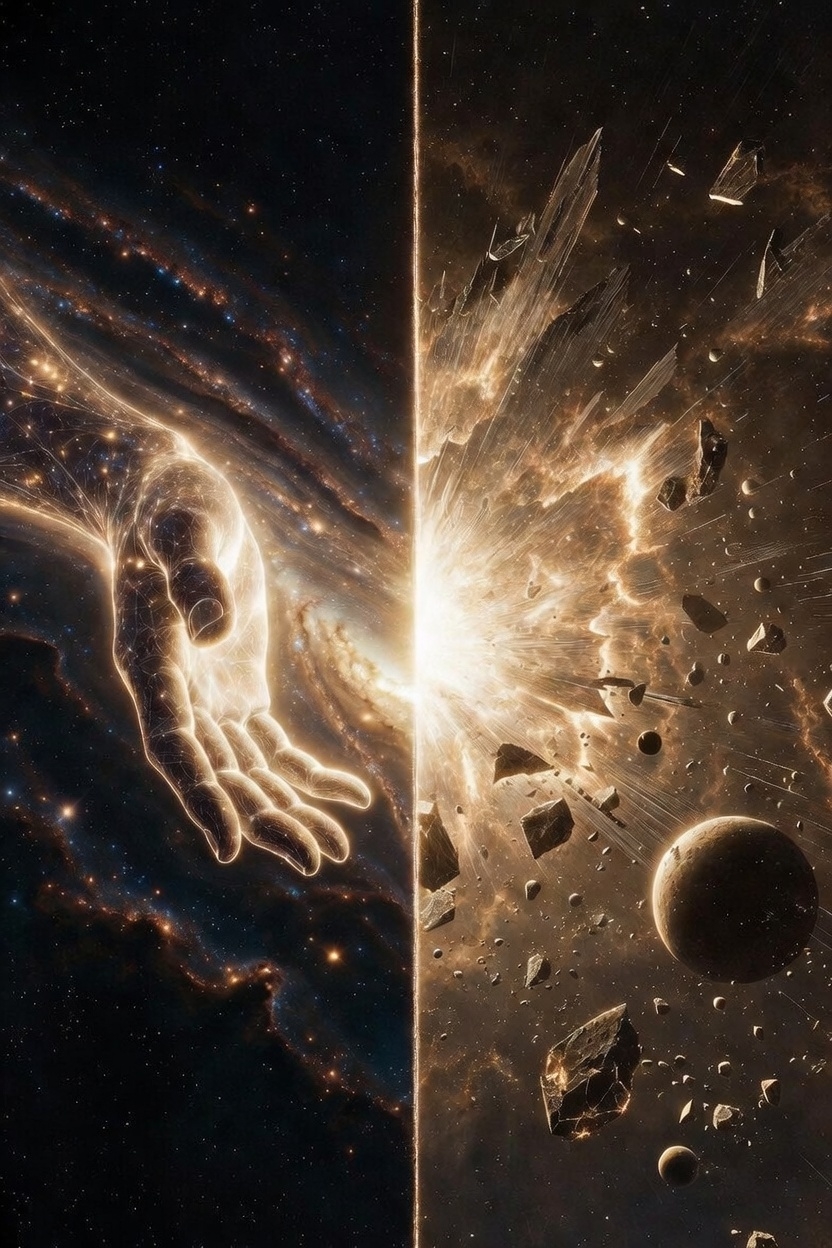
I like to think about our purpose as if we’re an invention. We didn’t create ourself so we’re not qualified to tell ourself what we were created for. For intense when you look at an invention you’ve never seen before, you’d have no idea of its purpose and the invention itself surely can’t tell you. We may articulate the most award-winning description of the invention, heck maybe you even get awarded a Nobel Prize. Guess what, it’s still just a guess. Only the creator or a patient description can tell us the purpose.
Some may claim, well DNA is our patient description. I do agree it’s a description to make us, a very good one indeed. However, it’s only a description on how to make humans, not why or the intended use of humans. That use case seems to be absent in the DNA code. Yet in this world we’re ushered to start seeking our life’s purpose by starting with a focus on self. With our existence not being one of our own creation, the purpose we fabricate will always lead to an impasse. When we begin at the source, with God our creator we see that we exist because God wills our creation. We were made by God for his purpose and with unconditional love. In my study, when you understand this, life takes on a whole new meaning.
Many people attempt at using self-actualization techniques to uncover their identity, purpose or destiny. It is only in God those discoveries are found and established as unwavering foundational truths. All other interpretations are building on quicksand, it may resemble solid ground but you cannot build generational principles on it. Acknowledging that you were created says that the creator of anything, anything that exists was created by something greater than that which already exists. If we self-ascribe these discoveries, we’re saying that we as an individual are greater than a creator of anything that exists. Essentially being our own creator or God, or alternately believing life was a random accident assigning man’s interpretation to life.
In our life today the more physicists, biologists, and other scientists learn about the world and space we inhabit, the more obvious it looks to be perfectly suited for our existence, custom-made to the exact specifications that allow human life to thrive. Only an artist can make things so beautiful.
As I studied “Sciences” popular theory of origin The Big Bang, it seemed in contradiction to the First Law of Thermodynamics, which says that matter is neither created nor destroyed; it can only be converted from one form to another. Some seem to justify it still follows the law by stating The Big Bang was the initial expansion of the universe itself containing all the energy, which caused the beginning of time. Nothing was created, nothing was destroyed. All that exists now existed then, merely in a different form. They’ll argue, there is no “before” the big bang because of this. In digging deeper and looking at the singularity point of The Big Bang where all known physical laws break down and the universe is thought to be compressed into an infinitely small space with infinite density, temperature and all the energy and volume of the universe in a single point. One must reckon to ask, “ok but where or how was that point of singularity created?”
From an interview Lee Strobel has in his book, Case for Christ with William lane Craig PHD, analytic philosopher and Christian apologist, records a powerful quote from a rigorous dialogue around the Kalam cosmological argument which premise is around whatever begins to exist has a cause and the universe began to exist. He notes,
It is the atheist who has to maintain, by faith, despite all of the evidence to the contrary, that the universe did not have a beginning a finite time ago but is in some inexplicable way eternal after all. So the shoe is on the other foot. The Christian can stand confidently within biblical truth, knowing it’s in line with mainstream astrophysics and cosmology. It’s the atheist who feels very uncomfortable and marginalized today.[1]
The Big Bang, which is this massive supernatural event seems unable to be explained within the realm of physics as we know it. Allan Rex Sandage an observational cosmologist says “Science had taken us to the first event, but it can’t take us further to the first cause.”[2] This sudden emergence of matter, space, time, and energy points to the need for some sort of architect. In this digital Information age and with AI, we can self-learn about anything. I’d suggest that if people spent a bit more time learning natural sciences rather than distracting themselves with digital media, they’d find it easier to see a creator with all the conflicting information around us. As Werner Heisenberg says “The first gulp from the glass of natural sciences will turn you into an atheist, but at the bottom of the glass God is waiting for you.” I observe most stopping after that first gulp.
In The Return of the Prodigal Son By Henri Nouwen, he goes on to explain the manipulation of individuals from a point of low self-esteem. I can draw a comparison to this very same playbook over ones understanding of a complex topic. One may think because they’re not “educated” with a paper label they can’t think, this is the furthest from reality.
Many consumerist economies stay afloat by manipulating the low self-esteem of their consumers and by creating spiritual expectations through material means. As long as I am kept “small,” I can easily be seduced to buy things, meet people, or go places that promise a radical change in self-concept even though they are totally incapable of bringing this about. But every time I allow myself to be thus manipulated or seduced, I will have still more reasons for putting myself down and seeing myself as the unwanted child.[3]
If given just enough to satisfy one’s urge the search may be over. But if you’re curious and seek a deeper understanding, more questions will arise and the “just enough” no longer satisfies. The world remains a mystery but that doesn’t mean man has to give an answer to something we might not be able to explain.
Keep the faith,
[1] Lee Strobel, The Case For A Creator (Michigan: Zondervan 2004) p. 148
[2] Lee Strobel, The Case For A Creator (Michigan: Zondervan 2004) p. 84
[3] Henri Nouwen, The Return of the Prodigal Son (New York: Doubleday1992) p.107
0 Comments